
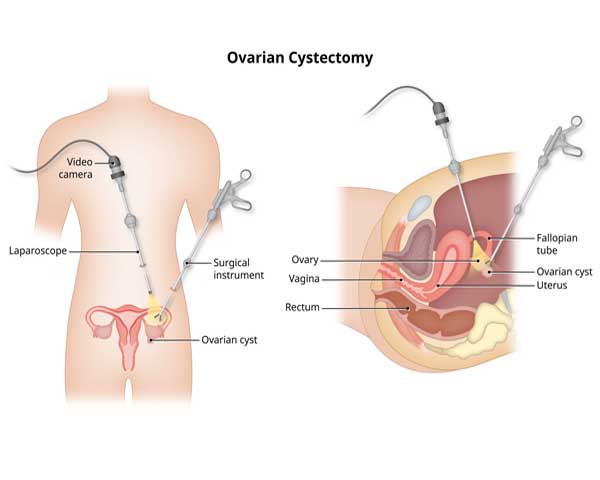
Ovarian Cystectomy is a surgical procedure to remove a cyst from the ovary while preserving the ovary itself. It is commonly performed when ovarian cysts are large, persistent, painful, or suspicious in nature. This procedure is often done using laparoscopy (keyhole surgery), which is minimally invasive and offers a quicker recovery.
What is an Ovarian Cyst?
An ovarian cyst is a fluid-filled sac that develops on or within an ovary. While most cysts are benign (non-cancerous) and go away on their own, some may:
-
Become large
-
Cause pain or discomfort
-
Lead to irregular periods
-
Affect fertility
-
Be associated with conditions like PCOS or endometriosis
-
Show signs of being cancerous
In such cases, your doctor may recommend surgical removal.
When is Ovarian Cystectomy Needed?
-
Cyst size is large (usually over 5–10 cm)
-
Persistent cyst not resolving with medication
-
Cyst causing pain or pressure symptoms
-
Cyst seen in postmenopausal women
-
Suspicion of malignancy (based on ultrasound or tumor markers)
-
Cyst associated with torsion (twisting of the ovary)
-
Fertility-preserving treatment in younger women
Types of Surgery
1. Laparoscopic Cystectomy (Minimally Invasive)
-
Performed through small abdominal cuts
-
Involves use of a laparoscope (camera-guided instrument)
-
Quicker healing, less pain, minimal scarring
2. Open Surgery (Laparotomy)
-
Required in large or complex cysts, or when cancer is suspected
-
Involves a larger incision and longer recovery
The decision depends on the cyst’s size, type, patient’s age, and fertility goals.
Procedure Overview
-
Performed under general anesthesia
-
The cyst is carefully removed from the ovary without damaging healthy tissue
-
If needed, the cyst is sent for biopsy to confirm diagnosis
-
The ovary is preserved in most cases, especially in young women
Recovery After Ovarian Cystectomy
-
Hospital stay: 1–2 days for laparoscopic surgery; longer for open surgery
-
Recovery time: 1–2 weeks for laparoscopy, 4–6 weeks for open surgery
-
Light activities can usually be resumed within a few days
-
Avoid strenuous activity or heavy lifting as advised by your doctor
Risks and Complications
Like all surgeries, ovarian cystectomy has some risks, though they are rare:
-
Bleeding or infection
-
Injury to nearby organs (bladder, bowel)
-
Scar tissue (adhesions)
-
Ovarian damage (very rare)
-
Recurrence of cysts
Fertility and Ovarian Function
In most cases, ovarian function and fertility are preserved after cystectomy. The procedure is especially beneficial for women who:
-
Wish to have children in the future
-
Have cysts associated with infertility (e.g., endometriotic cysts)
-
Are undergoing fertility treatment
Book Appointment